
Reflections from
my trip to Prague
A documentation of the 5-Day design sprint conducted with the team at Cisco AppDynamics, Prague
Published Sep 4, 2023 in Pen & Paper

If I am to define my experience in Prague in one word - that would be Bohemianism. It is a way of living life that revolves around the freedom of spirit and creativity, while also valuing self-expression, individuality, and embracing unconventional ways of living. As a T-shaped individual, this concept resonated with me, and the experience opened my mind in many ways.
Bohemianism is a social and cultural movement that promotes a way of life outside of society's conventional norms and expectations.
They say take a job that exposes you to new experiences. Oh, they are absolutely right. No doubt why Cisco is ranked as the #1 best places to work year after year. April'23 - I got an opportunity to visit the team in Prague and evangelize my design practice with the engineering and product team.
I am highly grateful to my mentors and colleagues who made this possible.
This blog is an attempt to document my 7-day journey in one of the most beautiful cities in Europe - Prague.
A 5-day design sprint, the primary objectives of which were to
Network | Co-create | Evangelize

This is what a product-building process looks like in most of the organization. The PM gathers the business requirement, passes it on to designers who then work on concepts, brings in research, UX writing if required, takes it to PM back, who then invites engineering to the table and it continues. The problem here is that work happens in siloes and leaves you with high chances of misalignment in the whole journey

NETWORK
The need of the hour!


There is no right time to involve the right team
Especially in the early stages of building a feature/product involving the cross-functional team helps in bringing functional diversity to the table to solve complex problems using creative thinking.
Kolache is an iconic breakfast staple in the Czech Republic. This doughy, fruit-filled pastry is typically enjoyed with a cup of coffee. As an Indian, I found it to be a new experience since our taste buds are accustomed to having something savory for breakfast, even then I hogged on 3 of them without any guilt. They told me they often visit Indian restaurants to have Biryani and to my surprise they hated whole cardamom in biryani too!
The timing couldn't be more right, a month before I visited Prague I finished this course on Cultural Sensitive Design Thinking - TU Delft and this turned my brain into a sponge which absorbed as much as it could without any bias.
Culture transfer

Have you ever thought about the different practices and rituals that are part of your daily life? How did these rituals come to be a part of your life? It's possible that some of them were influenced by other cultures, such as visiting a place for holidays or being influenced by a friend from a different background. Take a moment to reflect on how these practices have become a part of your life.
Thanks to Hyderabad, I discovered what I love having for breakfast: Dosa. And one funny anecdote I remember from my time in Hyderabad is when my friend Abdul told me that when someone says "Miyan main 10 minutes me aa raha hu" you need to by default make peace with the fact that that person is going to take good 30-40 minutes, and it worked 8/10 times for me.
Kolache - Czech dessert
Link to course

Co-create
Designing for with Engineers
Breaking the ice with engineers can be challenging at times, and we often label it as "ugh, they won't get it" I was in the same boat when I joined Cisco, and a few months into the job, one of my favorite things was to open a dialogue and brainstorm with engineers on different topics. They bring in a fresh perspective and are a wealth of ideas.
The product we craft for our users stands among the multitude of products they engage with each day, making it a vital part of their daily experience.
During my time in Prague, one of the coolest skills I picked up was learning to collaborate closely with engineers, talking their talk, digging deep with questions, getting their process, and weaving it into my work.
Designing for developers is an exciting place to be in, one might argue that "Hey engineers in your team are not your end users, so getting their views on your work does not add a lot of value" This is the common misconception in the world of product design. I firmly believe in harmonising the experiences around the ecosystem of other tools that our end users consume. This article on designing for devs beautifully articulates the patterns common across all developer tools.
So how do you foster that relationship with the engineers?
Design being one of the youngest field to be introduced in tech industry, often devs dont feel comfortable or are unaware of what value we bring into the product building process, use this opportunity to educate them about the designers roles & responsbilities, ask them what do they think our work consists of?
Avoid overloading the conversation with UX laws and frameworks instead pickup a project outside your work domain and walk them through the process you applied and put more emphasis on the impact the project made.
Start with who you are and what you do

Turns out engineering team there is a big fan of TinTin, and they have implemented the wit and humor of tintin's adventure into some of the cool stuff they are building
Get them involved in the early stages of design process
This worked like wonder for me, often our ideas lack the technical validation and reviewing our concepts early with engineers opens up world of new possibilities and at it keeps you grounded.

The image above is a visual representation of one of the projects where I involved engineering in early stages of design process.
Worked really well I must say!
Reason your design decisions
Trust me, no one is going to be influenced, especially engineers if you say "I have made xyz change because this is the best experience we can provide to the user" As designers we need to go an extra mile to reason our decisions.
Go back to 3rd century and try making an statement "I believe the earth is round" you are going to make flat earthers really mad!
The image here is an example from a recent project I was working on where I did a UX benchmarking of our competitors and I broke down the information hierarchy using Gutenberg's principle and then used the learnings to influence my designs

3
2
1
Other People Shoes
Brain-browsing activity where the intention is to empathise with a character and solve a problem in their shoes.

EVANGELIZE
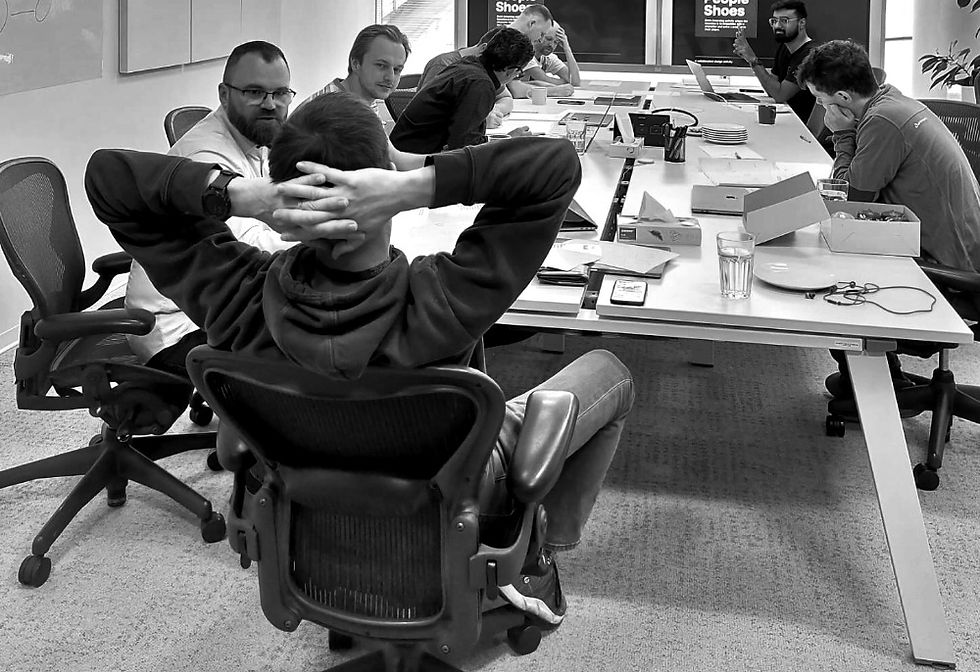
One of the key objectives of this trip was to work with the team to validate and conceptualize ideas I can build upon after I return to India. I used this fantastic opportunity to moderate a design workshop with the team to make it happen.
Note : The structure of this workshop was inspired by toolkits provided by IDEO, IDF, HBR CSD - TU-Delft. I tweaked them to my use-case and it worked really well.
Workshop layout
Introduction
3 mins
In my previous experiences, I have observed that 20% of the workshop time goes away in educating participants how to use tools, and setting expectations right, and then you have to cut down/compromise on the outcomes
you want.
Sending them a pre-read document 2 days before the workshop and a reminder a day before works just right to make sure they are well prepared for the activities that follow.
Provide your participants
a pre-read document preferably 2-days before the actual workshop
On the day of the workshop, start with a quick introduction and walk participants through the different activities involved as briefly as possible
10 mins
Ice-breaker session

Regardless of who your audience is, I have learned that getting people warmed-up before the workshop is crucial.
I tweaked the 30-circle ideation activity into a 8-circle ice-breaking activity where participants draw inside the circle based on a prompt provided to them

Everyone from the Prague team just came back from the Easter holidays the week I was conducting this workshop, and I asked them to sketch how their holidays was, there was slight hesitation in the beginning to sketch but with the prompt that was given they got excited to draw and share their experiences.
Know your audience and design your activities around them!
45 mins
Design activity
The activity is further broken down into 4 parts
The shoes 5 min
This is where you introduce the main story characters. I had created 4-persona cards and distributed them amongst the participants and gave them 5 mins to read and empathize with the shoes they are putting in.

In my use case, since my participants were a group of Devs, SREs. I limited the information on these cards to - what the character is good at & the areas where they need to rely on third-party (person/machine)
The journey 20 min
This is a user-journey mapping exercise where you need a set of specific use-cases for each characters you have defined. Make sure the use-cases are articulated well enough to avoid any vague assumptions. In my scenario I teamed up with the product manager to draft the set of use-cases

The next step is where the participants map the different steps involved in finishing the task as defined in the use-case. The cognitive load graph helps us capture which tasks are more overwhelming, the participants were instructed to start the task at any state but finish the job in the lowest cognitive state possible
The high-scoring tasks provide an opportunity to discuss interventions aimed at reducing cognitive load.

Pain points 10 min
Once participants map the journey, the next step is elaborating on the tasks that lies high on cognitive load. Here you can ask the participants to detail it out using examples from their experiences with similar situations
Here the participants are asked to brainstorm on a solution for the pain points they mentioned in the earlier step. The solution need not be in the form of wireframes/sketches. Instead give participants the freedom to articulate their thought process in any form of communication
The fix! 10 min
4
I had a 4 team of 2 people each, and equal time was assigned to the team to share their work. The participants were advised to elaborate on the pain point and the solution they devised for it.
Shareout 30 mins
Cultural chasm 2 mins
Over the past few years, we have all come to terms with a hybrid way of working and adapted to the challenges that it poses. However, collaborating virtually can be difficult, especially when working with a global team. While timezone differences can be managed, communication can be a challenge. I had a hard time conveying my ideas effectively to the engineers, and it was primarily due to the cultural differences between us.
Our perception and communication of thoughts are heavily influenced by our cultural background. For instance, it might be challenging to explain the concept of log parsing to colleagues in the US using examples from an Indian local vegetable market. During brainstorming sessions, our engineers often used analogies from the transportation system, which I had trouble relating to until I visited Prague. While in Prague, I was impressed by how everyone in the office used the public transportation system, which is ranked among the best in the world.

This experience piqued my curiosity, and I wanted to understand how each individual's cultural values align with professional values. To achieve this, I used a framework from the CSD-TU Delft course to map every person's socio-cultural dimension.


One of the most interesting takeaways from this activity was that 90% of individuals approached work with a fun and positive attitude and were highly expressive about their emotions.
Outcomes
Marcus Lemonis defined the 3 Ps of a successful business as - people, process, product. It's fascinating that these 3Ps also apply very well to your identity as an individual in any organization. In this 5-Day sprint, I was able to hone my people, process, and product skills and I came back with both short-term and long-term actionable insights.
In those 5 days we were able to close all open threads and within a month we released a product that allows our customers to query any MELT data in their infrastructure : Query Builder

Read more
Read the design philosophy and dive into the process I applied while designing for Query builder
We brainstormed collectively on finding the best possible solutions for a wicked problem with an initiative called : Schema browser. Things that would have taken weeks to agree upon were closed in a day.
Read more


The sole objective of this trip was to connect the UQL team, PM, UI engineers, and UX to handle deeply technical tool concepts that must be designed to keep end-users at the center of the whole experience.
I am grateful for the chance to work with the team in person, as remote work would have been impractical due to the project's complexity.
Summary in numbers:
• 1 Product designer in Prague
• 4 days of workshops
• 9 meetings with the UQL and UI team in person!
• "n" ML of Pilser Urquell :p
• 1 Prague tour led by amazing guide Martin Mares!
• 5 liters of coffee
• 45 sketches
• 60 pages of notes
• 2 kg of sugar per person (authentic Czech sweets)

Martin.M - Said - Michal - Pavel.C - Pavel.B - Marek - Stepan - Vojta - Eduardo - Martin.H - Zaneta - Siraj - Shalini - Moupiya
Big thanks
and everyone from the Prague team
Prague in pictures


děkuji
Storytelling with a UFO
Oh, what would I do without Beethoven? His 5th symphony has helped my creative juice flow in desperate times. Music is a powerful tool that can regulate emotions and boost productivity. Studies suggest that music is highly beneficial when it does not have lyrics. And it has been found to improve our performance on ...
